Services · Automation
One hour a day of repetitive work adds up to more than a month a year.
That's 22 hours a month and 264 a year, spent copying, checking and sending reminders. We connect the tools you already use and automate what doesn't need a human decision, always after understanding the process. Automation should take repetition away, not add complexity.
The problem
How repetitive work shows up in your day
Ring any bells?
- Someone copies the same information from one system to another every single day
- The same report gets put together by hand every week, always with a typo somewhere
- Invoices, confirmations and reminders depend on someone remembering to send them
- The process lives in one person's head, and that person will take a holiday at some point
- Your tools don't talk to each other, so people do the connecting
What changes
What comes off your team's plate
- Information that used to be copied now moves between systems on its own
- What needs to happen after each sale happens without anyone remembering
- Reports arrive ready, always in the same format
- When something fails, someone finds out right away, not weeks later
What's included
What we can automate and connect
-
System integrations
Tools that don't talk start exchanging information on their own, with no one in the middle.
-
Post-sale workflows
Confirmations, invoices, reminders and sign-ups triggered by the event itself.
-
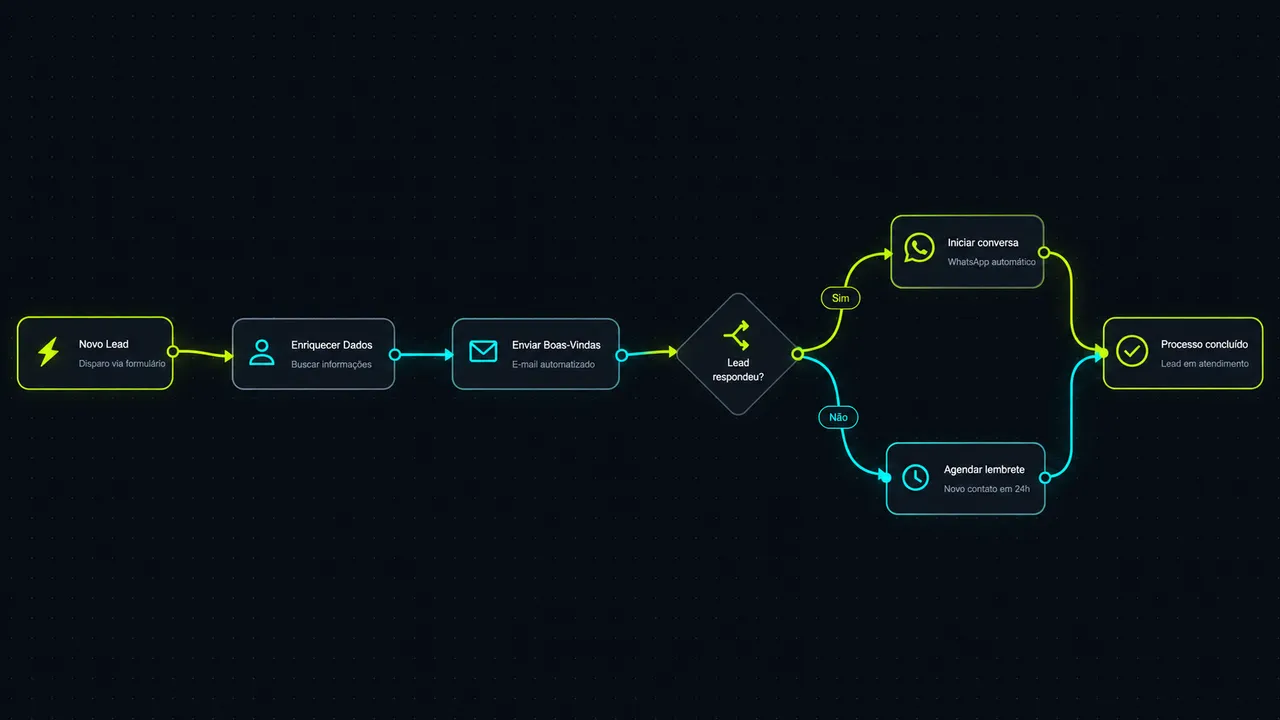
Lead qualification
Questions, scoring and routing every enquiry to the right place.
-
Automated reports
The numbers someone used to compile by hand arrive ready on the right day.
-
Operational alerts
The right person gets notified when something important happens, or when something stops.
How we approach it
Automating a bad process just makes mistakes happen faster
That's why automation is the last step, not the first. First, we map the process the way it really happens, exceptions included. Then we separate what needs a person from what doesn't. Only then do we connect the tools.
Every automation we build starts with a rule that sounds obvious and few people follow. Failure can never turn into silence. We learned that with our own automated Instagram conversations, when a read error meant people replied and got nothing back. Today, if one of our automations stops, someone is notified.
From manual work to a monitored process
-
Manual process
What gets done, by whom and how often.
-
Decision
What needs a person and what doesn't.
-
Integration
Your tools start exchanging information.
-
Automation
The repetitive work runs on its own.
-
Monitoring
Alerts when something fails and tracking of what changed.
Tools we've already used on this sort of project. We pick them once we understand the problem, not before.
- Instagram (DMs)
- Notion
- Cal.com
- Make
- Telegram
- Meta (Facebook and Instagram)
Where we've used it
Real work, and we tell you what stage each project is at.
Client projects and our own technology. The label tells you which is which.
Automated lead qualification
An Instagram DM conversation that qualifies people who ask for an assessment, saves them to the CRM and flags anyone who stalls halfway.
Find out more Our own technologyFrom booking to CRM
Every booked appointment creates the contact's card in the CRM, with their answers, without anyone typing.
Find out moreWhen it makes sense
This isn't the answer to every problem.
Telling you when it isn't right for you is part of the job. Sometimes the answer is something else, and sometimes it's leaving well alone.
It's worth it when
- The task repeats often and always follows the same logic
- The same information passes through more than one tool
- There's a step that tends to get forgotten and costs a lot when it does
- The process is clear enough to be written down step by step
It isn't worth it when
- The process isn't defined yet and everyone does it differently
- The task happens a few times a month and takes a few minutes
- Each case needs a different judgement call, and automating it would remove the care customers value
- A tool you already pay for has the automation built in and just needs turning on
Frequently asked questions
Will I have to make anyone redundant?
That's not the goal. What usually happens is the same team handles more volume without working late, and your most expensive people get back to the work only they can do.
What if my process is very specific?
Almost all of them are. That's why we start by looking at your operation instead of offering a ready-made package. Specific processes are exactly where generic tools fail.
Will it break when something in the business changes?
A living operation changes, and automation has to change with it. It's delivered documented, with alerts when something fails, and with ongoing support for clients who choose it.
Where do we start?
With a conversation about how the work happens today. It shows which repetitive task costs the most, and it's almost never the one you'd expect.
You might also look at
Software, automation and AI

Get in touch
Which task in your business repeats the same way every week?
Tell us what it is. We'll look at whether it should be automated, organised first or simply stop existing.
Rather use email? dreamharboragency@gmail.com