Services · Practical AI
AI only matters when it improves a task, a decision or a customer conversation.
A language model on its own doesn't know your stock, your prices or your rules. The real work is connecting AI to what your business knows, defining what it can do and, above all, what it can't.
In more detail AI customer service
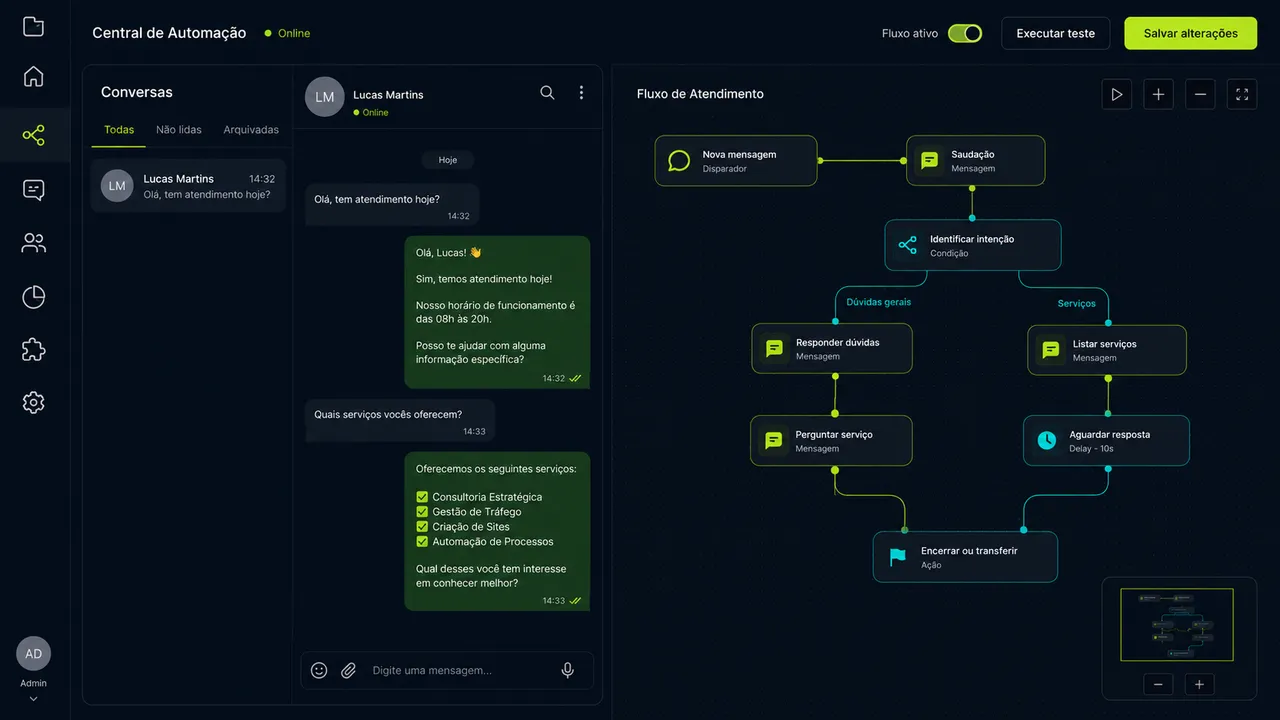
The problem
Where AI tends to disappoint
Ring any bells?
- The chatbot answers anything with confidence, including what it doesn't know
- Someone signed up for an AI tool, tested it for a week and forgot about it
- Customers can tell within two messages that they're getting canned replies
- Your business knowledge is scattered, so the AI has nowhere to get the right answer
- Nobody can say what the AI costs per month or what it actually solved
What changes
What changes when AI has context and limits
- It answers based on your business data, not guesswork
- When it doesn't know, it says so and hands off to a person
- Every action it can take is defined up front, and everything else stays locked
- You can see what it solved and what it cost
What's included
Where we apply AI
-
Customer service
Answers customers based on your real catalogue, stock and rules, and brings in a person when needed.
See it in detail -
Triage and qualification
Reads what comes in, understands the topic and routes it to the right place.
-
Internal knowledge
Your team asks and gets pointed to the answer, with the source, instead of interrupting someone.
-
Reading and sorting
Documents, conversations and forms organised without someone reading them one by one.
-
Assisted writing
Drafts, summaries and descriptions written by AI and reviewed by a person.
-
Questions about your numbers
Plain-language questions answered from your operation's real data.
How we approach it
AI reads, suggests and answers. The rules decide what it's allowed to do
In the agents we build, everything the AI can look up becomes a tool with a name and read-only permission. Changing the system is still a person's job. Sensitive data, like a customer's phone number, never goes through the AI.
We use the simplest model that does the job and step up to a more capable one only when the question calls for it, which keeps costs predictable. And whenever possible, the business uses its own account with the AI provider, so the usage and the cost stay in its name.
How an AI answer gets put together
-
Question
From a customer, your team or a document.
-
Real data
Stock, catalogue, rules and history.
-
Limits
What it can read and what it never does.
-
Answer
Or a handoff to a person.
-
Tracking
Cost, accuracy and what needed a human.
Tools we've already used on this sort of project. We pick them once we understand the problem, not before.
- Claude (Anthropic)
- Chatwoot
- Whisper
- Supabase (Postgres)
Where we've used it
Real work, and we tell you what stage each project is at.
Client projects and our own technology. The label tells you which is which.
Stock dashboard assistant
Answers the team's questions about items, approvals and stock movement by reading the shop's system, without being able to change anything.
Read in Portuguese In testingVirtual fashion consultant
A customer service agent connected to a shop's real stock that checks availability before answering. Currently in testing.
Read in Portuguese Our own technologySintetizador
An in-house tool that transcribes audio and video on our own machine and turns the content into usable knowledge.
Find out moreWhen it makes sense
This isn't the answer to every problem.
Telling you when it isn't right for you is part of the job. Sometimes the answer is something else, and sometimes it's leaving well alone.
It's worth it when
- Similar questions are eating up your team's day
- The right answer depends on information that already lives in some system
- There's too much text, paperwork or conversation for someone to read and sort
- An AI mistake would be manageable, or there's human review along the way
It isn't worth it when
- A simple rule would solve it, and AI would only add cost and unpredictability
- A mistake would have serious consequences and there's no way to have human review
- The information the AI would need isn't organised anywhere
- The only goal is being able to say your business uses AI
Frequently asked questions
Can the AI make up an answer?
Language models can be confidently wrong, which is why the design matters more than the model. The AI answers from your business data, is instructed to say when it doesn't know, and what it can do is limited by rules. Where a mistake would be costly, there's human review.
Will my business data be used to train someone's AI?
We use AI providers through their commercial API, whose terms don't allow the data you send to be used for training models. Even so, only the information the task needs goes to the AI, and sensitive data stays out.
How much does it cost to keep an AI running?
There's a usage cost that depends on volume and on the model. That's why we measure from day one and choose the simplest model that does the job. That cost is estimated with the project, before anything is turned on.
Will AI replace my team?
It takes the repetitive part of the work off your team. Judgement, relationships and decisions are still human, and that's what the extra time is for.
You might also look at
Software, automation and AI

Get in touch
Is there a task in your operation AI might handle?
Tell us what it is. Sometimes the answer is AI, sometimes it's a simple rule, and we'll tell you which.
Rather use email? dreamharboragency@gmail.com